
Growth journey of Python. Why Python for DevOps ?
Python’s popularity story is a bit like a slow-burn movie that suddenly turns into a blockbuster:
1. Early Years (1991–2000) – The niche scripting language
- 1991 → Python was released by Guido van Rossum.
- Mostly used in academia, research, and small internal scripts.
- Not mainstream — C, C++, and Java dominated professional software development.
2. First Popularity Boost (2000–2010) – The web era starts noticing Python
- 2000 → Python 2.0 introduced list comprehensions, garbage collection, and Unicode support.
- Frameworks like Zope, Plone, and later Django (2005) made Python attractive for web apps.
- Google adopted Python internally (Larry Page famously said, “Python where we can, C++ where we must”).
- Popularity still modest compared to Java, PHP, and .NET, but the developer community started growing.
3. The Big Takeoff (2010–2016) – Data science & DevOps era
- 2010+ → Rise of DevOps tools like Ansible, SaltStack, and Fabric — all Python-based.
- 2012–2015 → Data science exploded with NumPy, Pandas, scikit-learn, and Jupyter Notebooks.
- Python became the lingua franca for automation and analytics.
- Cloud platforms started offering Python SDKs first (AWS boto3, GCP libraries, etc.).
4. The Boom Years (2016–present) – Machine learning + general-purpose dominance
- 2016–2018 → Deep learning frameworks like TensorFlow and PyTorch cemented Python as the go-to ML language.
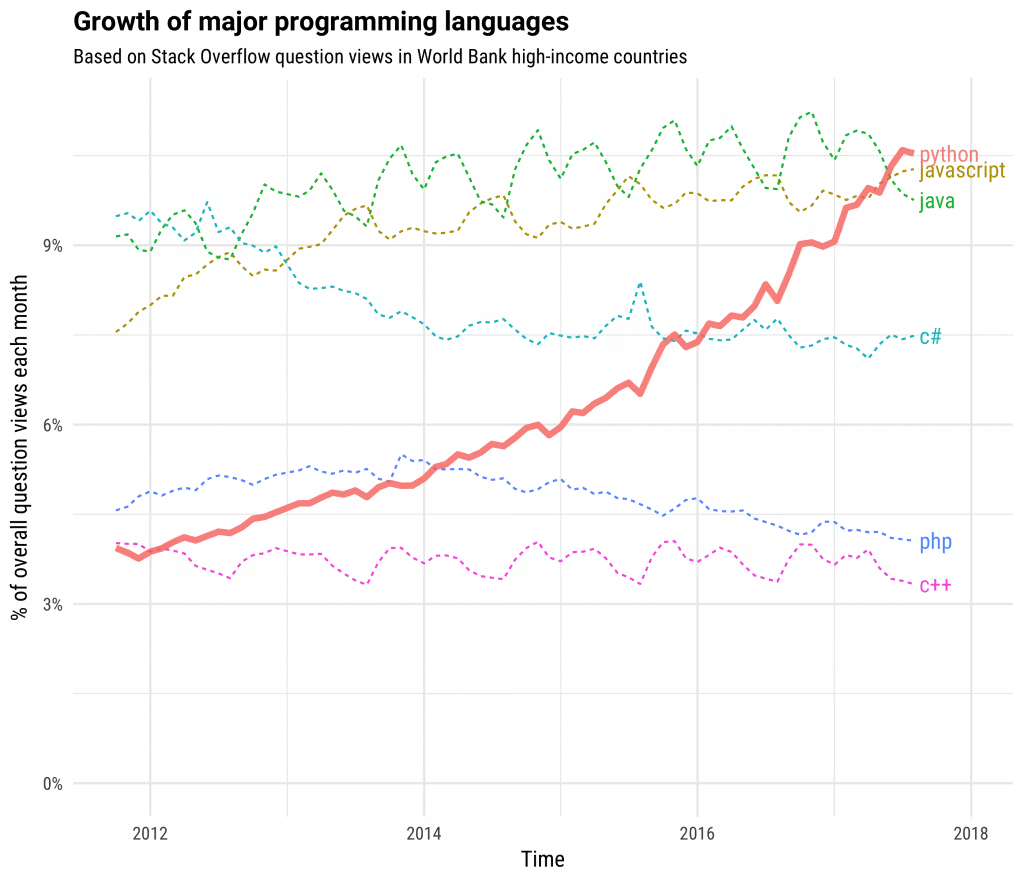
- Python surpassed Java in some rankings (TIOBE, Stack Overflow trends) around 2017–2018.
- Massive adoption in:
- DevOps (scripting, automation, IaC tools)
- Data science
- Education (Python replaced Java/C++ as the first programming language in many universities)
- Web development (Flask, FastAPI, Django)
If you look at Google Trends or Stack Overflow Developer Survey:
- Around 2010 → Python was still “nice to know.”
- Around 2015 → Python became “must know.”
- By 2018 onward → Python was the most popular language in many surveys, especially for automation, ML, and scripting.
Why Python for DevOps ?
1. Scripting vs. Enterprise App Language
- DevOps work often involves quick automation, glue code, and infrastructure scripting rather than building large enterprise backends.
- Python is a scripting-friendly language:
- No compilation step — you just run it.
- Syntax is concise and readable, so you can write and maintain scripts faster.
- Java, while powerful, is more verbose and requires compilation, making small automation tasks slower to develop.
2. Speed of Development
- Python has minimal boilerplate — writing a file manipulation or API call might take 5–10 lines in Python versus 20–30 in Java.
- This speed matters in DevOps, where you often need to prototype and deploy automation quickly.
3. Rich DevOps Ecosystem
Python has direct, ready-to-use libraries for DevOps tasks:
- Cloud Automation:
boto3(AWS),google-cloud,azure-sdk - CI/CD: Integrations with Jenkins API, GitLab API, GitHub Actions scripts
- Infrastructure as Code:
Ansibleis Python-based;Terraformcan be driven with Python wrappers - Container & Orchestration: Docker SDK for Python, Kubernetes
kubernetes-client - System Automation:
fabric,invoke,paramikofor SSH
Java can do these things but usually lacks the same quick, well-documented tooling for ops scripting.
4. Better Integration with DevOps Tools
- Many DevOps platforms (Jenkins, Ansible, SaltStack, Airflow) either use Python directly or offer first-class Python SDKs.
- Even where tools are language-agnostic (like Kubernetes), Python often has the most complete and actively maintained client library.
5. Learning Curve for Cross-Team Collaboration
- In DevOps, scripts may be read or maintained by sysadmins, network engineers, or testers who aren’t hardcore developers.
- Python’s readability makes it easier for non-developers to modify and maintain automation scripts.
- Java’s strict object-oriented style can be overkill for quick fixes.
6. Runtime Footprint & Portability
- Python runs on almost any system with just an interpreter — perfect for deploying small scripts inside containers or VMs.
- Java apps require a full JVM, which adds complexity and size, especially for small automation tasks.
7. Community & DevOps Mindshare
- The DevOps community heavily favors Python for automation examples, tutorials, and templates.
- That means faster problem-solving when searching for solutions online.
Rule of thumb in DevOps:
- Use Python for automation, integration scripts, CI/CD pipelines, cloud resource provisioning, and quick infrastructure tooling.
- Use Java when you’re building a full-scale, high-performance backend service or microservice that needs to run 24/7.